
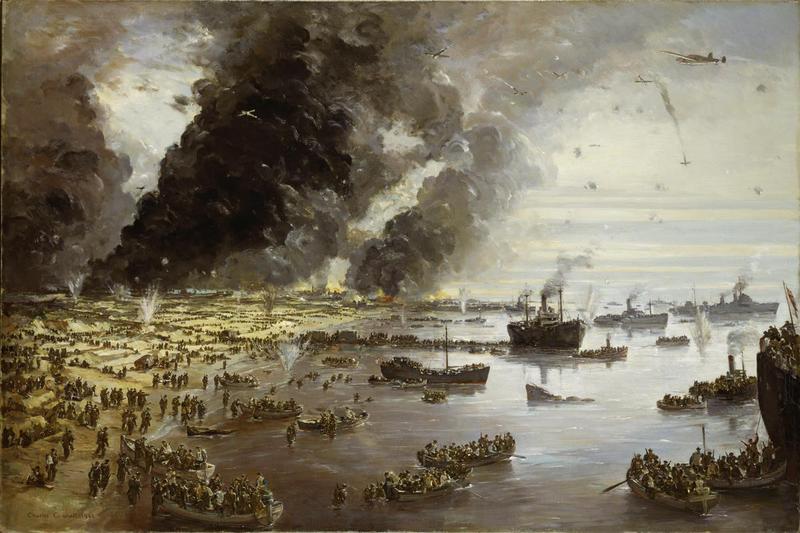
The evacuation of the British Expeditionary Force across the English Channel from Dunkirk on the French coast was hailed in Britain as an extraordinary achievement and the ‘little ships of Dunkirk’ swiftly entered the mythology of wartime brave deeds. German advances across Belgium and Northern France forced the BEF west towards the Channel and the evacuation began on 27 May, ending on 4 June. It was clearly a race against time with large numbers of troops at risk from the unprecedented speed of the German advance. An array of small civilian vessels from the British coast came to the aid of the overwhelmed troopships, helping to evacuate as many troops as possible. 200,000 British and 140,000 French troops were evacuated, the operation continuing until the last possible moment. Once the fighting reached the town of Dunkirk, burning oil tanks sent a characteristic black pall of smoke across the coastline. Cundall’s painting illustrates the drama of the last day of evacuation where troops are still being taken off the shore while under attack. The work celebrates the role of the little ships removing soldiers from beneath the threatening war clouds to the relative serenity of the vessels in deep water. The painting was commissioned by the War Artists Advisory Committee soon after the event and was then shown at the National Gallery, becoming a popular propaganda image of British endurance.